
Every founder asks me some form of this question in the first conversation, and it makes sense why they’re worried. You’re about to hand money to Google or Meta with no track record to prove it will come back. Most of the advice out there tells you how much to spend on ads as a percentage of revenue, which is a strange answer to give someone who doesn’t have revenue yet. So let’s start with the question you’re actually asking, not the one the generic guides answer.
Why “Spend X% of Revenue” Doesn’t Work When You’re Just Starting
The most common number you’ll see is 7 to 8 percent of revenue. Gartner’s 2026 CMO Spend Survey puts marketing budgets at 7.8% of company revenue this year, and plenty of agencies repeat a figure in that same range as a rule.
Here’s the problem. That math assumes a number you don’t have yet. If you haven’t made any sales yet, or you’ve only just started making them, 8% of your sales is either zero or too small to do anything with. The percentage rule is genuinely useful, but only once a business has enough sales history for a percentage of it to mean something. Right now, at the start, you need a different kind of answer.
The Actual Minimum: What Ad Platforms Need to Learn
Here’s what almost nobody explains clearly, and it matters more than any percentage rule. Google and Meta don’t just show your ad and count clicks. Their systems run a machine-learning process behind every campaign, and that process needs a minimum amount of data before it can work properly.
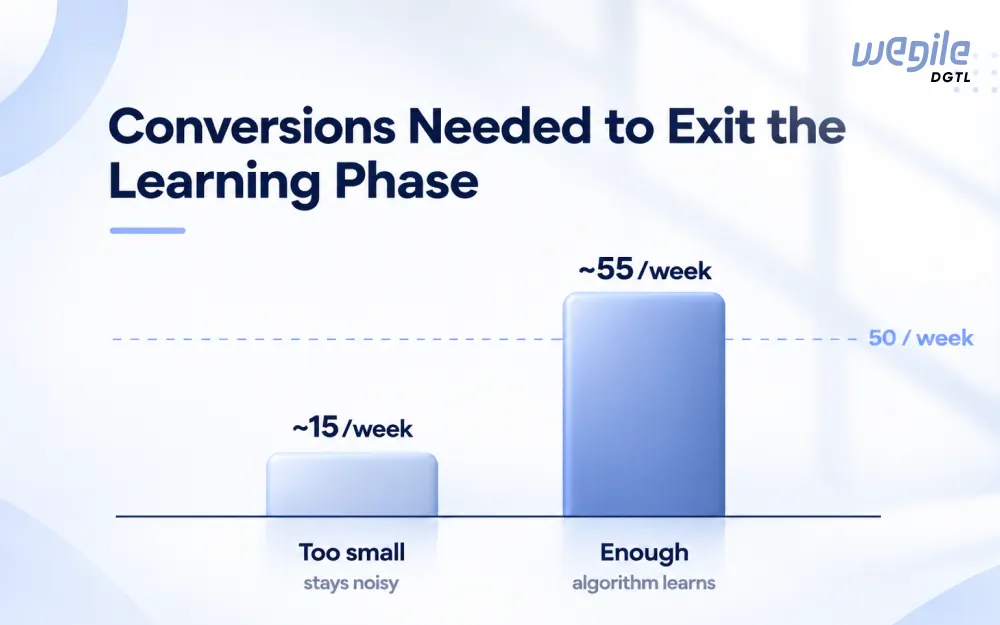
Meta calls this the “learning phase.” According to Meta’s own Business Help Center, an ad set becomes “learning limited” when it’s unlikely to get around 50 optimization events in a week. Below that threshold, the delivery system can’t gather enough signal to know who to show your ad to, so your results stay noisy and expensive. Google Ads runs a similar automated bidding process. Give it too little volume, and the algorithm never gets the data it needs to optimize.
This is the real answer to “what’s the minimum ad spend to see results.” It’s not a percentage of your revenue. It’s whatever budget gets you close to that weekly conversion threshold, given your cost per conversion.
Here’s how to work out your own number. Estimate what a single conversion costs you, whether that’s a lead form fill, a booked call, or a completed sale. This varies enormously by industry, so don’t guess blind. Recent cost-per-lead benchmarks show restaurants and local retail often paying $15-30 a lead, home services landing anywhere from $25 to $110, and categories like legal, insurance, and healthcare routinely paying $100-190 or more. Treat those figures as the mature average, not what you’ll see in week one. A brand-new campaign almost always costs more per conversion at the start, since the algorithm hasn’t learned your audience yet and your targeting and creative haven’t been tested. Expect your early cost per conversion to run higher than the benchmark for your industry, then watch it come down as the campaign gets real data to work with. Look up where your own industry sits before doing any further math, since starting from the wrong number throws off everything that follows.
Once you have a real figure, multiply it by 50 to get a rough weekly budget. At $20 per conversion, that’s $1,000 a week. At $150 per conversion, the same math puts you closer to $7,500 a week, which is exactly why one flat starting-dollar number can’t work across every industry. A business selling a $2,000 service can usually justify its own version of that math quickly, whatever the number turns out to be. A business with a low-cost product or a high cost per lead often can’t hit the full weekly figure right away, and that’s fine. It just means your realistic goal for now is a smaller test, not a full exit from the learning phase.
Work out your own number
Enter what you expect one conversion to cost. The weekly budget is that figure multiplied by 50.
A $2,000 monthly budget would buy about 23 conversions a week at this cost, so treat it as a smaller test rather than a full exit from the learning phase.
Whatever your own number comes out to, it’s a very different exercise than “spend 8% of your revenue,” and it’s what actually determines whether your first campaign has a real chance to perform the way the platform is capable of, rather than producing noisy, expensive results with no clear signal.
Realistic Starting Budgets by Platform
None of this means you need to guess at a number that feels emotionally safe. It means picking a real figure based on what the platform actually needs to work with.
- Google Ads: cost per click commonly runs $1 to $5 depending on your industry and keywords, so a $50-60 daily budget buys a handful of clicks a day. That’s enough to start testing, though not enough to fully exit the learning phase on its own.
- Meta Ads: cost per click tends to run lower, often $0.50 to $2, which stretches a small budget further and makes Meta a common first platform for founders testing an ad budget for startups.
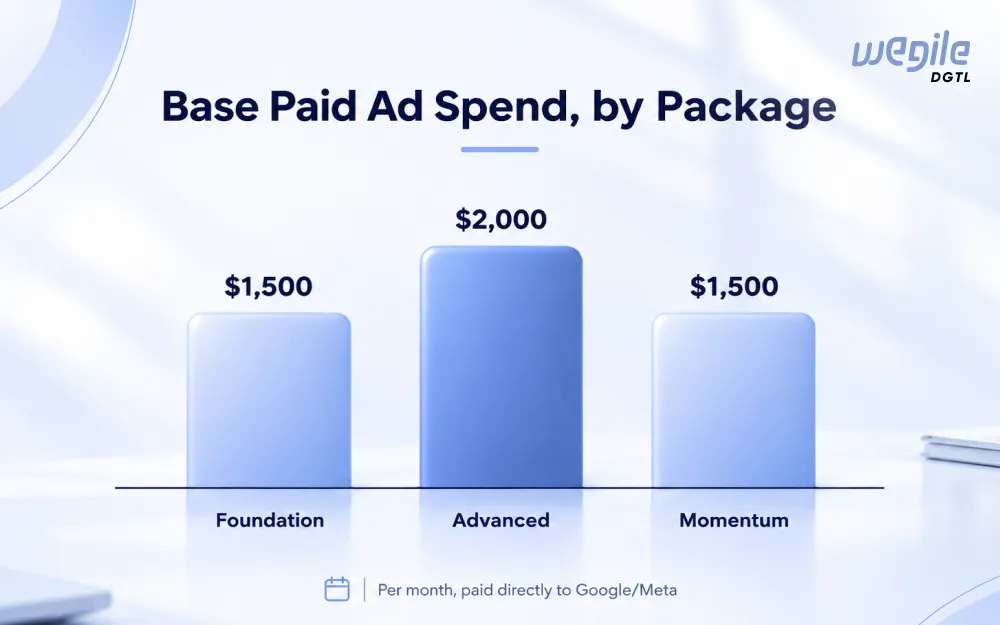
- A real base number: our own paid ads packages set a base paid ad spend of $1,500 to $2,000 a month depending on the package, and that range isn’t picked at random. It’s close to what it actually takes to approach the learning-phase threshold on one platform, which is why it holds up as a genuine starting figure rather than a guess.
- Which platform to pick first: choose Google Ads if your customers are already searching for what you offer, you offer a service people need right away, like an emergency repair or a same-day appointment, or you’re generating B2B leads. Choose Meta Ads if your product relies on strong visuals, you want to introduce your business to people before they ever think to search for it, or your main goal right now is brand awareness. Before deciding, check what your competitors are already running in Meta Ad Library and Google Ads Transparency Center, both free and need no login. If most of your competitors show up on one platform and not the other, that’s a real signal about where your audience actually is. Only run both platforms at the same time once your budget can support each one at a meaningful volume on its own, since splitting $1,500 across two platforms just slows down learning on both.
Pick a budget you can afford to spend every week for several weeks in a row, not a bigger number you could only manage once. A $1,500 budget spent consistently beats a $5,000 budget spent once on an untested offer.
Once You Have Revenue: The Percentage Rule That Actually Works
Once you have sales coming in, the percentage-of-revenue conversation becomes genuinely useful again, because now there’s a number to take a percentage of.
A business in its first year or two, still building awareness, usually needs to spend toward the higher end, often 10-15% of revenue, to keep growing. An established business with a steady customer base can often drop that closer to 5%, because a lot of its demand is already coming from repeat customers and word of mouth rather than every dollar of new advertising.
Industry and competition shift that percentage further. A local service business in a market with few competitors advertising online can often see results at the lower end of that range, because there’s less noise to cut through. A business in a crowded category like ecommerce fashion, insurance, or legal services is competing against advertisers with much larger budgets for the same audience, so it usually needs to sit at the higher end just to stay visible. Being at either end of that range is normal, not a problem. What matters is knowing which end actually applies to your business before you set expectations for what a given budget should deliver.
This is also the point where a lot of founders start managing more campaigns, more platforms, and more decisions than they have time for, which is where our paid ads management comes in for clients who’d rather hand the day-to-day optimization to a team that does this full time.
Treat Your Ad Budget Like a Test, Not a Bet
The mindset shift that matters most here has nothing to do with dollar amounts. Stop thinking of your ad budget as money you’re spending to get customers, and start thinking of it as money you’re spending to get information.
None of that information means anything if your conversion tracking isn’t set up correctly first, and this is where a lot of first-time advertisers go wrong without realizing it. If your website isn’t accurately reporting which clicks turned into a form fill, a call, or a sale, then every number you look at afterward, your cost per conversion, your ROAS, even whether you’ve hit that 50-events-a-week threshold, is built on bad data. Before you spend a dollar on the ad itself, confirm that a test conversion actually shows up correctly in your ads account. It’s a five-minute check that saves weeks of drawing the wrong conclusions from a campaign that was never being measured properly.
Run at least two versions of your ad, whether that’s different headlines, images, or audiences, so you’re comparing results instead of guessing. And look at your return on ad spend, not just your raw number of conversions. Say Version A brings in 40 leads at $15 each, and Version B brings in 25 leads at $20 each. Version A looks cheaper on paper, but if Version B’s leads convert into paying customers at twice the rate, it’s actually the better investment. Raw conversion count without looking at what happens after the conversion tells you very little.
If one version of your ad still isn’t working after it’s had a real chance to get past the learning phase, turn it off and put more of your budget behind the version that is performing well. Turning off a weak ad isn’t a failure. It’s exactly why you test with small, controlled amounts instead of committing your full budget to one unproven ad.
When to Keep Managing It Yourself, and When to Bring In Help
Most founders don’t have much spare time, so running your own ads only makes sense if you’re realistic about what it actually takes. There’s no rule that says you have to hand this off right away. But managing it yourself only works if you can check the account daily, not just weekly, have the patience to let a test run its full course, and are genuinely willing to learn how the platforms work.
Bring in help when the campaigns start eating more hours than they’re worth, when you’re not sure whether a result is good or just average for your industry, or when the budget has grown large enough that a mistake carries a real cost. At that point, it’s worth knowing what professional management actually costs. Our pricing page lays out the real numbers. It’s a 20% management fee on top of whatever you spend directly with Google or Meta, with a base paid ad spend of $1,500 to $2,000 a month depending on the package. That base figure is described honestly as a lean starting point, not a requirement, which matches everything above. It’s meant to be enough to get real data, not a number you’re locked into.
Final Thoughts
There’s no single number that answers how much to spend on ads for every business, but here’s a specific one to start from. Pick one platform, Meta or Google, not both, and put $1,500 to $2,000 a month behind it, the same base range we set for our own paid ads clients. Aim for close to 50 conversions in a week, since that’s the point where the algorithm actually has enough to work with, but don’t be discouraged if a high cost per lead keeps this budget from getting you there. A business with a low-cost product or a high cost per lead often can’t hit the full weekly figure right away, and that’s fine. It just means your realistic goal for now is a smaller test, not a full exit from the learning phase. Once you have data proving an offer works, scale the budget up from there, and that’s also the point where the 8% of revenue conversation stops being theoretical and starts being useful.
Want a team to run the day-to-day optimization for you?
See Wegile DGTL paid ads management