

Most advice for landscaping businesses describes the year the same way: busy in spring and summer, slow in winter, with one long slow stretch to save money for. That picture fits a company that cuts grass and maintains garden beds. It doesn’t fit a landscape lighting company. Landscape lighting demand doesn’t drop for one long stretch and come back. It rises sharply at certain points in the year and falls at others, and those points aren’t even the same from one landscape lighting company to the next.
What the Landscape Lighting Seasonality Problem Actually Looks Like
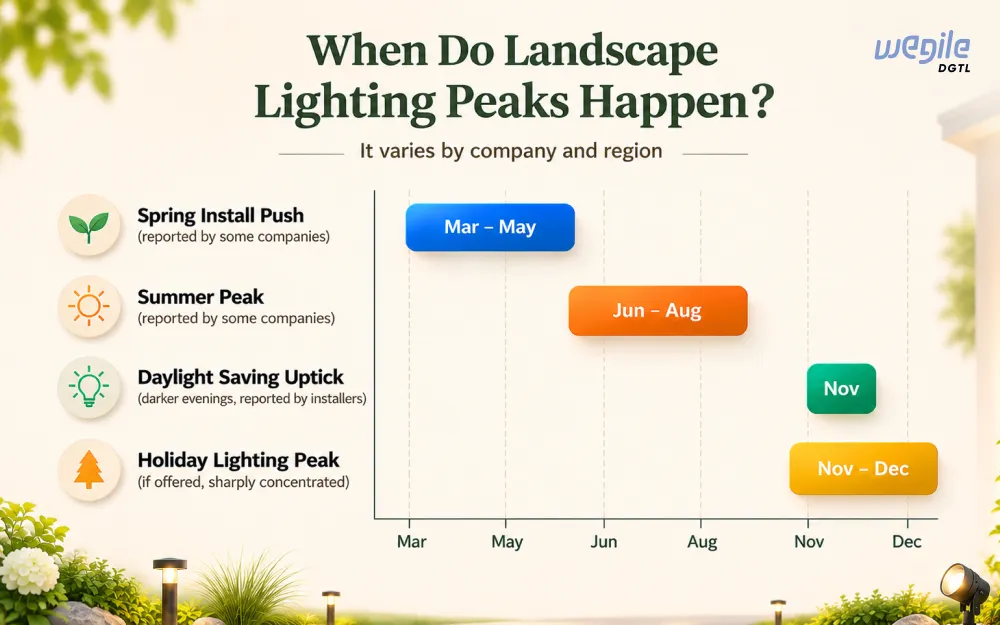
A mowing and maintenance business really does have one flat off-season. Once the grass stops growing and fall cleanup is done, there’s nothing left to sell until spring arrives. Landscape lighting is different. Installation demand concentrates at certain points in the year, holiday lighting (for companies that offer it) concentrates sharply around November and December, and the rest of the calendar is comparatively quiet. That’s not one slow season. It’s real peaks with real gaps between them, and getting the timing of your marketing wrong costs you a specific peak, not just “the slow months” in general.
Landscape Lighting Business Seasonal Demand Isn’t the Same for Everyone
Here’s where the pattern gets less clear, and where a lot of generic advice oversimplifies: industry sources and installers don’t agree on exactly when the main installation peak happens. Some contractors describe spring as their busiest season for new installs. Others push hard for fall installs, specifically because fall tends to be a quieter period with more open scheduling capacity, not because demand is highest then. Others still see their real peak in mid-summer, when outdoor living season is already underway and homeowners are investing in their yards anyway. A separate, consistent pattern shows up around daylight saving time ending: when evenings get darker earlier, homeowners notice a dark yard and start calling. And for companies that add holiday lighting to their lineup, that work is its own distinct, sharply concentrated peak late in the year, separate from core landscape lighting installs.
None of this means the pattern is random. It means the pattern is company-specific and region-specific, shaped by climate, install conditions, and whether holiday lighting is part of the business. The mistake isn’t failing to know the “right” calendar. It’s assuming there’s one right calendar and copying a generic version of it instead of looking at your own numbers.
What the Search Data Actually Shows
It’s worth checking an assumption that seems obvious: if evenings get darker in the fall, shouldn’t interest in landscape lighting go up then too? A Google Trends analysis covering 2022 through 2025 found the opposite for this specific term. While search interest in categories like warm lighting and cozy lighting jumped sharply from summer to fall, interest in landscape lighting specifically dropped by about 4%, moving against the broader seasonal lighting trend.
That doesn’t mean the daylight-saving uptick installers report is wrong. Search interest and actual installation demand aren’t the same measurement. A homeowner who already knows which company they’re calling, because a neighbor referred them or they’ve used that company before, never shows up in a Google search at all, even though they still become a paying customer. A drop in search volume doesn’t necessarily mean a drop in actual bookings; it may just mean fewer people are starting their search on Google that season. But it’s a useful check on assuming any single explanation (daylight saving, fall curb appeal, holiday season) fully accounts for your own demand pattern. The only way to know your actual peaks is to look at your own booking and revenue history by month, not borrow someone else’s.
What Getting the Timing Wrong Actually Costs You
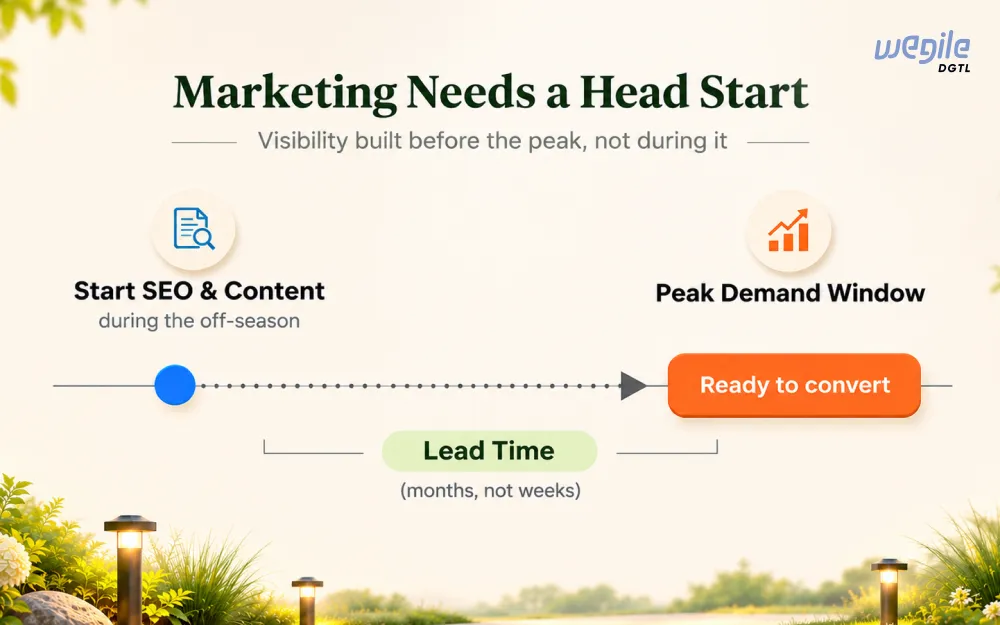
Whatever your specific peaks turn out to be, marketing built around them has to start before they arrive, not once they’re already underway. SEO and content take months to build enough visibility to show up when someone searches. A paid campaign needs time to gather enough data to run efficiently. If you wait until a peak has already started to ramp up marketing, you’ve already missed a meaningful share of that peak’s demand, and the next one might be months away.
This is also where cash flow and staffing get squeezed. Revenue concentrated in a few windows means fixed costs (insurance, core salaries, equipment) still have to be paid in between them. Businesses that don’t plan for this often end up financing the gap with credit or losing trained staff between peaks, then paying to rehire and retrain before the next one.
Fix 1: Build Visibility Before Your Peak, Not During It
The practical fix for landscape lighting slow season marketing is to work backward from your actual peak, not react to it. SEO and content take real time to build, usually 3 to 6 months, so if your busiest install window is spring, that work needs to start in the dead of winter, when it feels like nothing is happening. If holiday lighting is part of your business, the marketing push for it needs to start before Halloween, not after Thanksgiving. The off-season isn’t dead time to pause marketing. It’s the only window where marketing has enough lead time to actually be ready when demand shows up. Our landscape lighting SEO guide walks through what that early groundwork actually involves.
Paid search works on a shorter clock, often weeks rather than months, but the timing principle still matters. Waiting until a peak has already started to turn on or increase a campaign means paying premium rates, since every competitor bidding on the same searches is doing it at the same moment. Shifting budget and messaging a few weeks ahead of the season, instead of reacting to it, is the difference between competing for a peak and missing most of it.
Work backward from your own peak
Pick the month your busiest window starts, based on your own booking history. The timing below uses the lead times above.
Fix 2: Diversify Inside Lighting, Not Just Away From It
A lot of generic seasonality advice tells landscaping businesses to add unrelated services during slow periods: power washing, hardscaping, xeriscaping. Those can work for a general landscaping company, but they pull a lighting-focused business away from the one thing its brand and crew are actually built around. If you’re wondering how to market landscape lighting year-round without turning into a different kind of business, the answer is diversifying inside lighting itself: maintenance plans that keep existing installs running (bulb and transformer replacement, seasonal timer adjustments), smart-lighting upgrades for past customers, and event or commercial lighting work that doesn’t follow the same residential calendar at all. Each of these uses the same skills and equipment your crew already has, and each one smooths out revenue without turning your company into something it isn’t.
Fix 3: Plan Cash Flow and Staffing Around Your Actual Peaks
Once you know your own real pattern, planning for cash flow and staffing gets much easier. Instead of guessing, set aside enough money ahead of time to cover the actual gap between your peaks, not a generic estimate based on “winter is slow.” If you take deposits for installs or holiday lighting, don’t spend that money right away. You’ll still need to buy materials and pay your crew to finish that work later, so treat deposits as money already spoken for, not extra cash on hand. On staffing, the companies that come out of each off-season in the best shape are usually the ones that find a way to keep their core crew paid through the quiet stretch, either through the adjacent lighting work described in Fix 2 or through money they set aside in advance, instead of laying people off and having to hire and train a new crew again before the next peak.
How Wegile DGTL Times Marketing Around Real Peaks
We’ve seen this pattern directly with Elevated Seasons, a landscape lighting client whose results you can see for yourself. For this client, the real pattern is two sharp peaks, summer installs and Christmas lighting, with a quieter stretch between them, not a steady curve across the year. Because SEO and content take months to build momentum, the client’s two best months are effectively decided months earlier, well before either peak arrives. We shift budget and messaging ahead of each season rather than during it, and keep leads that come in during the quieter months warm with follow-up instead of letting them go cold, so they’re ready to convert once the next peak starts.
Final Thoughts
Some landscape lighting companies see their main install push in spring, some in fall, and almost all see a sharp, separate bump around the holidays if they offer that work. None of that comes from a generic calendar. It comes from looking at your own booking and revenue history, still the only reliable way to know your pattern for certain. What stays the same across every version of that calendar is the principle: the marketing that fills a peak has to start before it does, not during it. Fix the timing, and the “slow season” stops being a mystery and starts being something you planned for.
Want your marketing ready before your next peak, not during it?
See Wegile DGTL for landscape lighting