
Someone’s breaker switch just tripped for the third time tonight, or there’s a burning smell near an outlet, and they’re standing in their kitchen with a phone in hand. They’re not comparing five electricians. They’re searching once, calling the first business that looks like it’ll actually pick up, and moving on with their night. That’s the entire moment emergency electrician marketing is built to win, and most marketing advice for electricians doesn’t treat it as a different problem from a scheduled panel upgrade or a lighting install.
It is a different problem. A homeowner planning a rewiring project researches for days. A homeowner with sparks coming out of an outlet doesn’t research anything. They call the next business almost immediately if you don’t pick up. This post covers what it actually takes to capture that second kind of search, from the keywords people type in a panic to the call-handling setup that decides whether that traffic turns into a booked job or a missed call.
Why Emergency Searches Behave Differently Than Regular Service Searches
Most electrician marketing advice treats every search the same way, aiming to get found, get clicked, and get the call. That works fine for planned work. It breaks down for emergencies, because the buyer isn’t shopping anymore. They’re trying to make a problem stop.
A few things change once a search is genuinely urgent. First, price sensitivity drops. Someone with no power in half their house isn’t comparing three quotes. They’re calling whoever can show up fastest. Second, trust signals matter less in the moment than they do beforehand. A five-star review doesn’t help if nobody answers the phone. Third, and this is the part most campaigns miss, speed to answer beats almost everything else on the page. If your ad, your website, and your Google Business Profile all look great but the call rings four times and goes to voicemail, you’ve already lost that customer to whoever picked up.
None of this means reviews, branding, and a clean website don’t matter. They matter for the research-phase customer who’s planning ahead, like someone looking into a generator or an EV charger. For the person in a genuine electrical emergency, your marketing only has one job. It needs to be the fastest, most obvious answer to “who do I call right now.”
Think about the two searches side by side. Someone researching a panel upgrade might open four tabs, read a pricing guide, check reviews across three platforms, and call back tomorrow after thinking it over. Someone with a breaker switch that won’t reset and a house that’s half dark isn’t opening four tabs. They’re tapping the first result that looks credible and has a phone number they can reach right now. Campaigns, landing pages, and even your Google Business Profile hours all need to account for the fact that these are two different buyers using the same search engine for completely different reasons.
What People Actually Search When They Have an Electrical Emergency
“Emergency electrician near me” is the phrase every guide mentions, and it’s a real one worth targeting. But it’s not the only way people search when something’s actually wrong, and a lot of that traffic gets missed because campaigns are built around one generic phrase instead of the actual symptoms people type.
Real emergency searches tend to describe the problem, not the service:
- “No power in half my house”
- “Breaker keeps tripping and won’t reset”
- “Sparking outlet”
- “Burning smell from outlet” or “burning smell electrical panel”
- “Lights flickering whole house”
- “Power out but neighbors have power”
These symptom searches often carry less competition than the obvious “emergency electrician” phrase, because fewer businesses bother building content or ad groups around them. Someone typing “sparking outlet” is arguably a more urgent lead than someone typing “emergency electrician,” since the second phrase could still mean they’re bookmarking a number for later. If your keyword strategy stops at “emergency electrician near me,” you’re leaving a real slice of genuinely urgent traffic for a competitor to pick up.
There’s also a voice and “near me” layer that’s easy to miss. A growing share of this traffic comes through a phone’s voice assistant rather than typed into a search bar, phrased more like a spoken question than a keyword, something like “who can fix a sparking outlet near me right now” instead of a clipped search term. Your Google Business Profile category, service list, and hours all feed into whether you show up for that kind of conversational query, so getting those fields accurate matters as much as the keywords in your ads.
The Real Problem With Emergency-Electrician Search Data
Here’s something worth being upfront about. If you go looking for how many people actually search “emergency electrician near me” every month, you’ll find numbers that don’t agree with each other at all. One keyword tool puts it around 10,000 to 12,000 searches a month nationally. Another puts the same phrase closer to 80,000. That’s not a small rounding difference. It’s roughly a sevenfold gap on the exact same search term.
Different tools pull from different data sources and sampling methods, so this kind of disagreement shows up more often than most marketing content admits. The practical takeaway isn’t to pick whichever number sounds better and build a pitch around it. It’s to treat any single search-volume figure as a rough directional signal, not a precise forecast, and to validate it against your own market with actual ad data once a campaign is live.
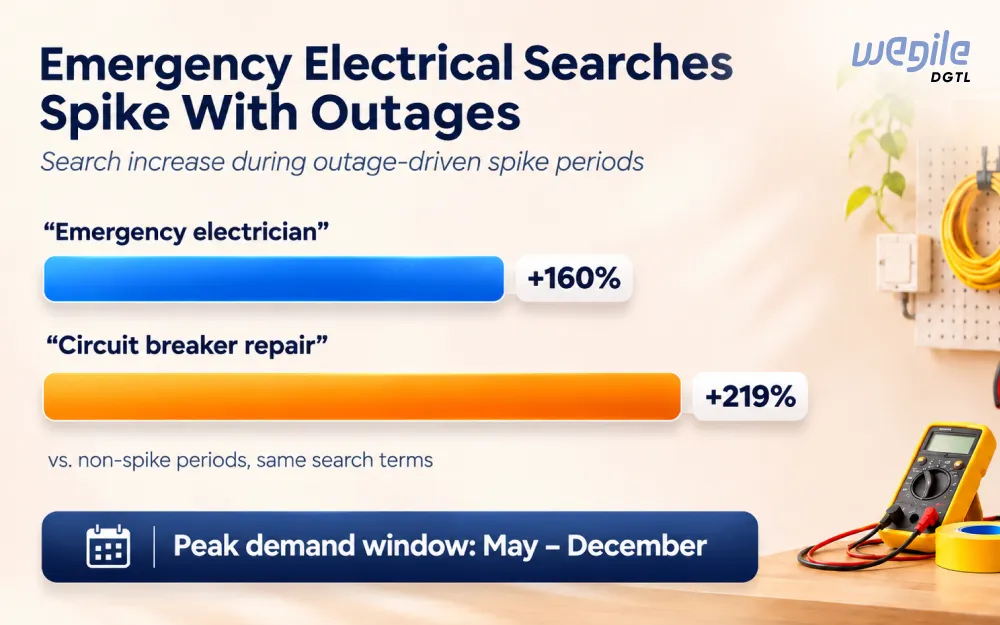
What’s more reliable is the seasonal pattern. A 2026 analysis using Ahrefs’ keyword data (covering January 2023 through December 2024, U.S. searches) found that “emergency electrician” searches spiked by roughly 160%, and “circuit breaker repair” by around 219%, during periods tied to power outages. That same analysis found electrical emergency search demand running highest from May through December, which lines up with storm season and the higher electrical load that comes with summer heat and winter heating. The exact months behind that percentage increase weren’t specified, so treat the trend itself as the useful part, not the number as a precise benchmark.
In practice, this means your emergency campaigns shouldn’t run at the same steady budget all year. They should be ready to scale up fast around storm season and local weather events, because that’s when the real spikes happen, regardless of which keyword tool’s baseline number you trust.
The same disagreement shows up in cost data. Published cost-per-lead figures for Google Local Services Ads in the electrical trade typically range from around $30 in smaller markets to $60-70 in major metros, while standard Google Ads for the same trade often run closer to $90-100 or more per lead, depending on the source and the metro. Rather than anchoring a budget on any single published figure, track cost per booked job from your own LSA and ad accounts after a few weeks live. That number, specific to your actual service area and your actual close rate, is worth more than any industry-wide average you’ll find in a blog post, including this one.
Which Channel Actually Captures the Right-Now Moment
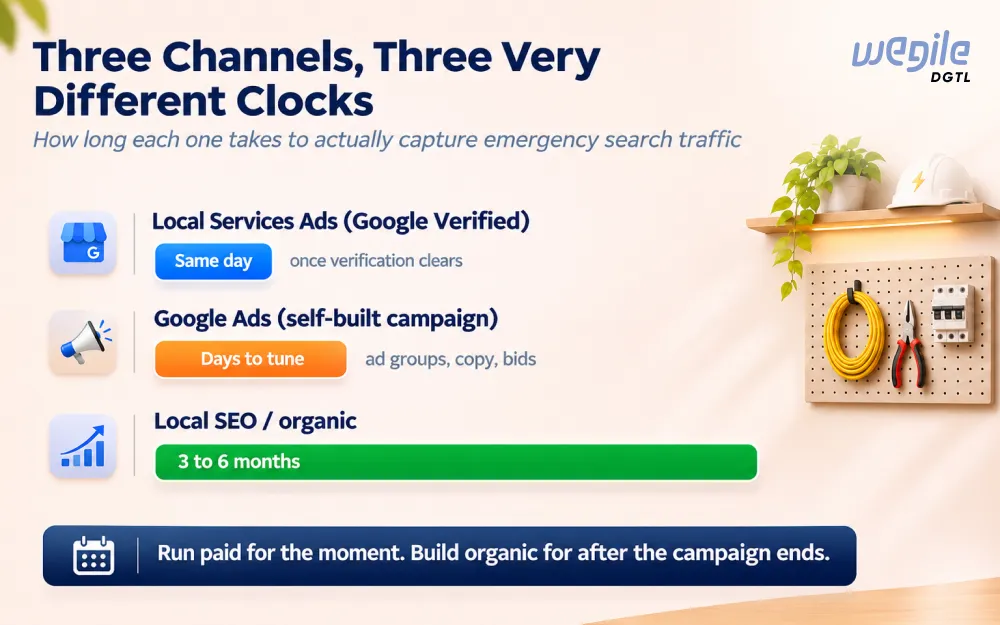
For a true emergency search, the channel that wins first is usually Google Local Services Ads (LSAs), and it’s worth being clear that this is a different product from a standard Google Ads search campaign, not just a setting inside one. Instead of writing keywords, ad copy, and bids yourself, you set up a verified business listing, and Google places it above regular search ads once that verification clears. That’s also why it can go live the same day, there’s no campaign to build and tune first, just an approval to clear. LSAs charge per qualified lead instead of per click. Getting approved means passing Google’s background check, license verification, and insurance review, a process that typically takes a few business days once your documents are in. That verification step matters for the buyer. When someone’s in a panic, the Google Verified badge next to your business name (Google’s current name for this, replacing the older “Google Guaranteed” and “Google Screened” labels) does real work in the moment it takes them to decide who to call.
It’s worth knowing going in that not every lead LSAs charge you for is a good one. Google allows disputing leads that are clearly spam, out of your service area, or for a job you don’t do, and it’s worth checking your lead log weekly rather than assuming every charge is a legitimate customer. Budgets here also don’t behave like regular search ads. You set a weekly budget target, but actual spend can swing above or below it depending on how many qualified leads come in, so check in on actual weekly spend rather than assuming it’ll land exactly on target.
Regular Google Ads still have a place, but they work better for emergency searches when they’re built as their own campaign, with emergency-specific keywords, a call-only or click-to-call ad format, and a landing page built for someone who’s about to tap your number, not browse your services. Mixing emergency and planned-work keywords into one campaign usually means your ad copy ends up generic enough to serve neither search well.
Organic search and local SEO matter here too, just on a longer clock. Ranking for emergency terms in the map pack and in regular organic results takes months of consistent Google Business Profile activity, review generation, and service-area content, not something you can turn on the week before a storm. The realistic approach is to run LSAs and paid search for the immediate moment while building organic visibility in the background for the searches that happen after the campaign budget runs out or before someone’s fully decided to search for help.
The Landing Page an Emergency Call Actually Needs
Almost every piece of advice on this topic says to send emergency traffic to “a dedicated landing page” instead of your homepage. Few of them say what should actually be on it. Here’s what that page needs to do its job.
A clear, immediate answer to “can you help me right now,” stated in the first line someone sees, not buried under a hero image and a mission statement. A phone number that’s tappable on mobile and visible without scrolling, since most of this traffic comes from a phone in someone’s hand, not a desktop browser. An honest response-time statement, something like “we answer 24/7” or “same-day dispatch,” only if it’s actually true, since a false promise here costs you a one-star review from someone who was already having a bad night. Basic trust signals that don’t require reading, like a license number and an insurance badge, placed near the call button rather than in a footer nobody scrolls to. And pricing transparency where you can offer it, even just a diagnostic fee range, because the uncertainty of “how much is this going to cost me” is often what makes someone hesitate to call at all.
What this page doesn’t need is your full services list, a blog roll, or a multi-step contact form. Every extra click or field is a chance for someone to decide calling a different business is faster.
Check your own emergency landing page
Open it on your phone, one-handed, and tick what is there.
Start with the first line and a tappable number. Those two do most of the work.
It’s also worth testing this page the way an actual panicked customer would use it. Open it on a phone with one hand, on a slow connection, and see how many seconds pass before you could realistically tap call. If that takes more than a few seconds, the page is working against the exact traffic it was built for.
Answering the Call Is Part of the Marketing
This is the part almost no electrician marketing guide covers, and it’s probably the single biggest reason good campaigns underperform. No amount of targeting and ad spend matters if the phone rings to voicemail at 11pm.
If you’re marketing yourself as available for emergencies, that has to be backed by an actual answering process, whether that’s a live answering service, an on-call rotation among your own technicians, or at minimum a system that texts back immediately when a call is missed. A missed call from an emergency search is worse than never running the ad at all, because you spent money to get someone to try you, and then handed that lead straight to the next search result.
Dispatch matters just as much as answering. Someone who picks up the phone but can’t say when a technician will actually arrive loses the advantage of answering quickly in the first place. If you can’t commit to a real arrival window on the call, at least be specific about when you’ll call back with one, and then actually call back.
This doesn’t require staffing a 24-hour front desk. A rotating on-call schedule among your own technicians, paired with a simple rule like “every call gets answered or texted back within two minutes, any hour,” covers most of what the marketing is promising. The tools matter less than the commitment behind them. A business that answers consistently at 2am with a basic phone tree will out-convert one with a polished ad and a voicemail greeting, every time.
How Wegile DGTL Approaches Emergency Electrician Marketing for Home Services Clients
For electrical contractor clients, we build campaigns around the same idea this post is making. Emergency search traffic and planned-project traffic need different timelines and different channels. Paid search gets a short runway, since those campaigns need to be live and tuned before the next storm or outage, not after. Local SEO gets a longer one, usually 3 to 6 months, since map pack visibility and service-area content build up gradually rather than switching on overnight.
Content built specifically for the outage-prep and “what to do before the electrician arrives” moment also feeds the slower side of this, since it captures people who are searching before things turn into a full emergency. A homeowner who reads a short guide on what to check before calling an electrician during an outage, written by a business that clearly knows the subject, is more likely to call that same business once the problem turns out to be bigger than a quick fix. That’s a slower kind of lead capture than an LSA click, but it compounds over time in a way paid traffic alone doesn’t.
There’s no universal fix here. Every service area has its own storm patterns, its own competitive density, and its own realistic staffing limits for after-hours calls. But treating emergency and planned-work search as genuinely different problems, with different timelines, different channels, and a call-answering process built to match, is the part most electrician marketing skips.
Final Thoughts
Speed decides who wins emergency electrician marketing, from the moment someone searches to the moment a real person answers with a real timeline. The electricians who consistently capture this traffic aren’t necessarily outspending everyone else. They’ve built every piece, from LSA verification to who picks up the phone at 2am, around the fact that this specific customer isn’t going to wait around and compare.
If you’re still working out how to split ad budget across channels for a home services business, our Google Ads vs. Facebook Ads guide walks through that decision beyond just the emergency-search piece covered here.
Want emergency campaigns live and tuned before the next storm?
See Wegile DGTL for electrical contractors