
If you search for marketing strategies for landscaping business growth, you’ll find plenty of tactics, sometimes ten, fourteen, even eighteen listed at once. What actually helps is knowing where to start. A landscaping company running one or two crews, with no dedicated marketing team, needs a short, focused list more than a long one.
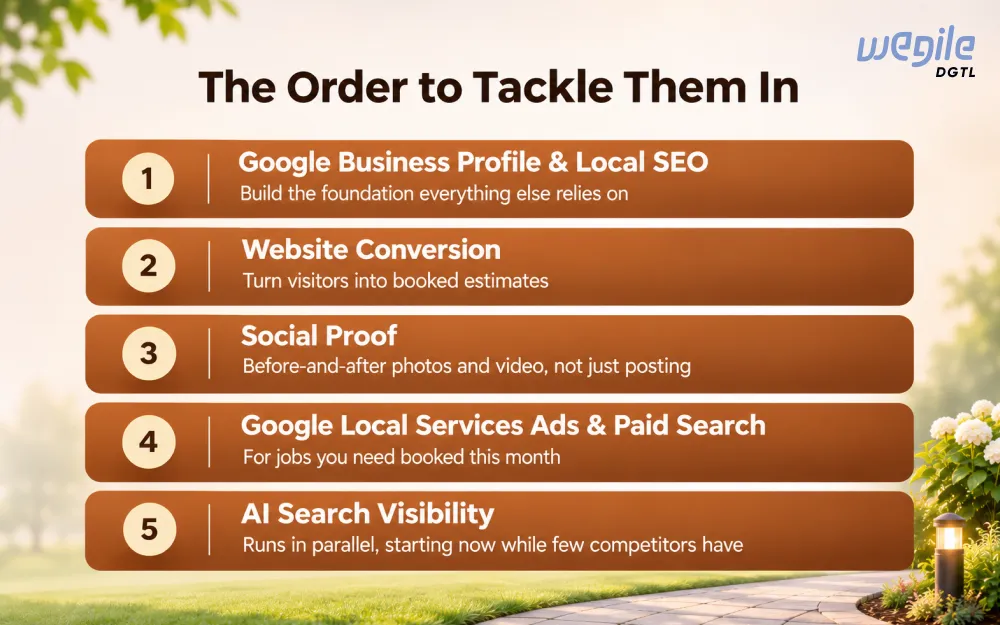
Here’s that focused list: five strategies, in the order to tackle them. You don’t need to run all five at once. Most landscaping businesses are better off starting with just one, then adding the next once it’s actually working. Start with your Google Business Profile and local search presence. Then build a website that actually converts visitors instead of just existing. Use social media to show real proof of your work, not just noise. Add paid search for the jobs you need booked right now. And start building AI search visibility, a channel that’s still mostly untapped for landscaping businesses.
Claim Your Google Business Profile and Win Local Search
For a landscaping business, local SEO for landscaping companies starts and mostly ends with one thing: your Google Business Profile. When someone searches “landscaper near me” or “lawn care [their town],” the map pack above the regular search results is what they see first, and what it shows comes almost entirely from your profile, not your website.
A complete profile does more work than most owners expect. Fill in every service category you actually offer, not just “landscaping” as a single catch-all. List your real service area instead of leaving it default to a radius around your office. Add photos from real jobs regularly, since profiles with recent activity tend to rank and convert better than ones that sit untouched for months.
Reviews live inside this same profile, and they matter here more than almost anywhere else. A profile with twelve recent, detailed reviews reads as more trustworthy to both searchers and Google’s ranking systems than one with three reviews from two years ago. Ask for a review after every finished job, while the work is still fresh in the customer’s mind, instead of hoping someone remembers to leave one weeks later.
None of this replaces having a real website with service pages that match what people actually search for (“landscape design,” “lawn maintenance,” “irrigation install”), each one built around the actual service rather than one generic “our services” page trying to rank for everything at once. That groundwork is also what makes the next strategy possible.
Build a Website That Turns Visitors Into Booked Estimates
A landscaping website’s job isn’t to look good. It’s to turn someone who’s already interested into someone who requests a quote, and a lot of landscaping sites quietly fail at that second part even when they look fine.
Start with how the site works on a phone, since most of this traffic is someone standing in their yard or searching on a lunch break, not sitting at a desktop. A quote request form that asks for ten fields before someone can submit it loses people who would have called a competitor’s three-field form instead. Keep it short: name, phone number, address or zip code, and a line for what they need.
A few other things decide whether that visitor actually converts:
- Clear service pages, one per service, explaining what’s included and what happens next, instead of one page trying to cover everything.
- Real project photos, organized by service type, since people decide on landscaping work by seeing it, not just reading about it.
- A visible phone number and quote button on every page, easy to spot at a glance.
- Fast page load on mobile, so people don’t leave before they even see the quote form.
If the website already exists but was built years ago and never revisited, it’s worth auditing it against this list specifically, rather than assuming a site that “looks fine” is actually doing its job for new visitors.
Run Social Media for Proof, Not Just Posting
Social media is a common landscaping business marketing idea, but it’s often done wrong. Posting a lot isn’t the goal. The real job social media does for a landscaping business is build trust with someone who has never heard of the company before, and genuine photos of real finished jobs do that far better than generic posts.
Before-and-after photos of real jobs do more for a landscaping business on social media than almost any other content type, because the transformation itself is the sales pitch. A short video of a crew finishing a patio install, or a time-lapse of a lawn renovation, works the same way and tends to travel further than a static photo.
Organic posting builds familiarity in your own area over time, but it’s slow, and it mostly reaches people who already follow you. Paid social works differently: it puts your proof in front of homeowners in your service area who haven’t found you yet, which is a different job than organic posting does. Think of organic as keeping existing followers engaged and paid as the way to reach people who don’t know you exist yet, rather than treating the two as interchangeable versions of the same tactic.
Keep the content specific to real jobs and real results. Generic stock-style graphics or motivational quotes don’t do the same work as a photo your crew actually took this week, and they’re easy for a scrolling homeowner to ignore.
Use Google Local Services Ads and Paid Search for the Jobs You Need Right Now
Local SEO and social proof build up over months. Sometimes a landscaping business needs jobs booked this month, not eventually, and that’s what paid search is actually for.
Google Local Services Ads (LSAs) are usually the first paid channel worth testing for a landscaping business. Instead of bidding on keywords, you set up a verified business listing and Google places it above regular search results, charging per qualified lead instead of per click. The verification step (background check, license and insurance review) also puts a trust badge next to your name, which matters when a homeowner is choosing between several similar-looking landscaping companies.
Standard Google Search Ads still have a place alongside LSAs, especially for project-based work like hardscaping or landscape design, where someone is actively comparing a few companies and a well-written ad with real project photos can pull them toward a quote request. Keep maintenance-service campaigns (ongoing work like mowing or lawn care) and one-time project campaigns (a single job like a hardscaping install or a landscape design project) separate instead of combining them into one. The keywords people search, the ad copy, and even the best time of year to run the ads are different for each type of campaign.
These landscaping advertising strategies cost real money, and how much depends heavily on your market and your growth stage. If you haven’t worked out an actual number for what a landscaping company should spend on marketing, our landscaping marketing budget guide walks through the framework before you commit a paid search budget to any single channel.
Start Building AI Search Visibility Now, While Most Competitors Aren’t
The fifth strategy is a genuinely new opportunity: how your business shows up when someone asks an AI tool instead of searching Google the usual way.
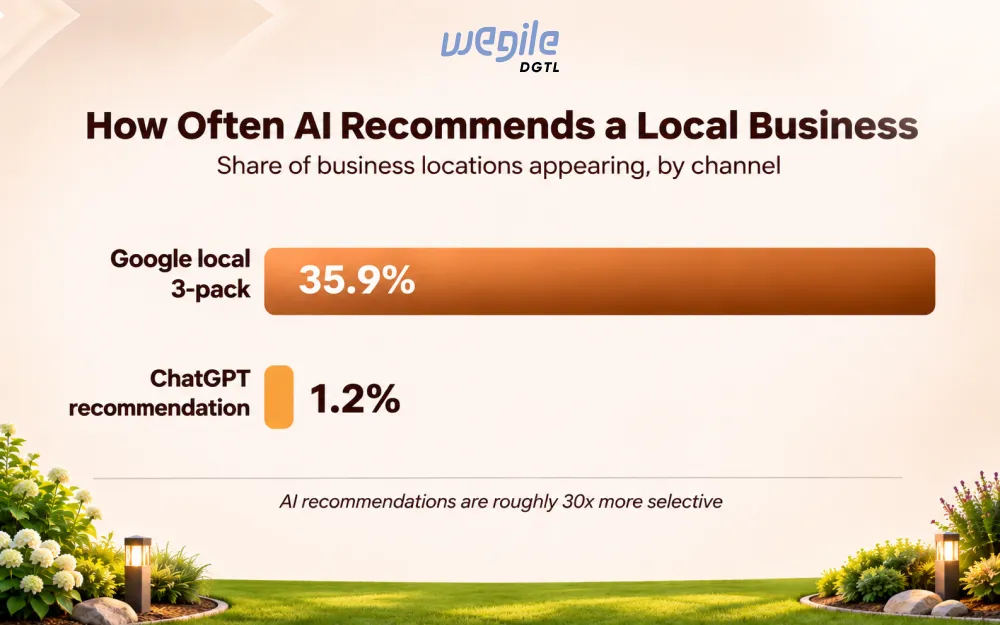
This isn’t the same job as ranking in Google’s regular local search results. A January 2026 analysis from Localogy, covering SOCi’s Local Visibility Index report, found that ChatGPT currently recommends only 1.2% of business locations it evaluated, compared to an average 35.9% appearance rate for the same locations in Google’s local 3-pack, making AI recommendations roughly 30 times more selective than traditional local search rankings. In plain terms, ranking well on Google doesn’t mean an AI tool will recommend you, and most landscaping companies that already do solid local SEO still aren’t showing up here.
The good news is that the groundwork is mostly the same groundwork from Strategy 1, just applied with more care. A complete, accurate Google Business Profile matters for both regular search and Google’s AI Overviews, since both draw from the same underlying data. Keeping your business name, address, and phone number identical across your website, your Google profile, and any directory listing (Yelp, Angi, local chamber sites) matters more here than it ever did for traditional SEO, since AI tools cross-reference that information across sources to decide whether to trust it. Basic structured data on your website (marking up your business as a LocalBusiness and each offering as a Service, in the page’s code) gives AI tools a clearer, more machine-readable version of the same information a human visitor reads.
None of this guarantees a mention from any specific AI tool, and it’s worth being upfront about that rather than overpromising it. What it does is put a landscaping business in a genuinely less crowded field, since most competitors haven’t started on this yet, while costing nothing beyond the time to clean up data that should have been consistent already.
How Wegile DGTL Approaches These Marketing Strategies for Landscaping Business Growth
For landscaping and lawn care clients, we build these five strategies as one coordinated plan rather than five separate projects competing for the same budget. Local SEO and Google Business Profile work builds the long-term foundation, paid search covers the gap while that foundation is still being laid, and the website and social proof pieces support both.
We’ve seen this work directly with a landscaping and outdoor living client: over a two-year partnership combining brand repositioning, Google Search and Performance Max campaigns, and an SEO strategy, the result was an 8.76x return on marketing investment, an 11.26x return on ad spend specifically, a cost per lead 2.28 times lower than where the client started, and a customer acquisition cost 3.82 times lower. That result came from running SEO, brand work, and paid search together, deliberately, rather than treating each one as its own disconnected budget line.
Final Thoughts
Pick one of these five strategies to start, not all five at once. For most landscaping businesses, that’s Strategy 1: get the Google Business Profile and local search presence fully built out, since almost everything else on this list works better once that foundation is actually in place. Add the website fixes next, then social proof, then paid search when you need faster results than SEO alone can deliver on its own timeline. AI search visibility can start in parallel with any of these, since it mostly reuses the same data you’re already cleaning up for Strategy 1.
Marketing strategies for landscaping business growth don’t need to be a list of eighteen things done halfway. Done well, in order, these five get real results, and there’s always room to add more once they’re working.
Want these five run as one coordinated plan?
See Wegile DGTL for landscaping